
Seedance 2.5 pricing on Seedance25.tools starts at $9.90 for a one-time pack of 99 credits. The platform currently offers four credit bundles — Starter, Basic, Plus, and Professional — with no recurring subscription and no expiration date on purchased credits. Every paid pack uses the same Seedance 2.5 model, supports output up to 4K, removes the watermark, and includes commercial-use rights.
The main differences between the plans are the number of credits, effective cost per credit, render-queue priority, support level, and concurrent generation limit. This means the best Seedance 2.5 pricing plan depends less on feature access and more on how frequently you create videos, which resolutions you use, and how many attempts you typically need before approving a final output.
This guide explains the current Seedance 2.5 pricing and cost structure on Seedance25.tools, including credit rates by resolution, estimated cost per video, reference-video surcharges, plan selection, commercial licensing, and practical ways to reduce the Seedance 2.5 price of each usable clip. It also places Seedance 2.5 pricing next to published prices from Kling, Veo, and Sora so you can evaluate where your budget delivers the most value.
The prices in this guide apply specifically to Seedance25.tools and should not be interpreted as official ByteDance or BytePlus API pricing, because other platforms and API providers may use different rates, billing units, and usage rules.
Compare the available plans and start creating with Seedance 2.5.
Seedance 2.5 Pricing at a Glance
Seedance25.tools currently uses one-time credit packs rather than monthly subscriptions. Purchased credits remain in the account until they are used.
Plan | One-Time Price | Credits | Cost per Credit | Queue and Concurrency | Best For |
|---|---|---|---|---|---|
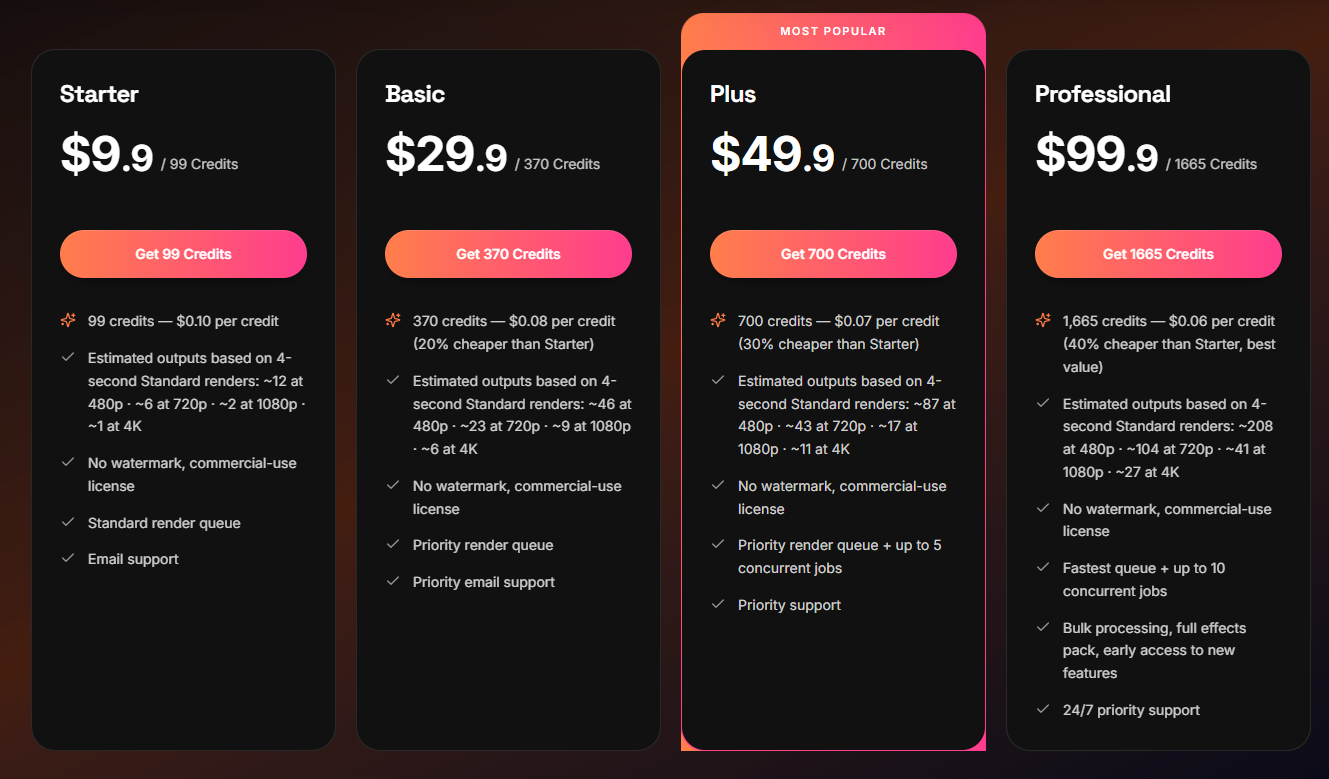
Starter | $9.90 | 99 | $0.10 | Standard queue, 1 job | Initial tests and occasional clips |
Basic | $29.90 | 370 | $0.08 | Priority queue, 1 job | Solo creators with regular projects |
Plus | $49.90 | 700 | $0.07 | Faster priority queue, up to 5 jobs | Active creators and small teams |
Professional | $99.90 | 1,665 | $0.06 | Fastest queue, up to 10 jobs | Agencies and high-volume production |
Starter provides the lowest purchase price, while Professional provides the lowest effective cost per credit. Compared with Starter, Basic reduces the per-credit rate by 20%, Plus by 30%, and Professional by 40%.
All four Seedance 2.5 pricing packs provide the same core model, maximum resolution, watermark policy, and commercial-use permissions. Users are therefore choosing a production volume rather than paying to unlock a more capable version of the model.
How Seedance 2.5 Pricing Credits Work
A key detail of the Seedance 2.5 pricing model is that the platform does not charge one fixed number of credits for every video. The final generation cost is mainly determined by output duration, output resolution, Standard or Fast mode, and whether a qualifying reference video is attached.
The generator calculates and displays the required credits before the user submits the task. This allows creators to adjust the duration, resolution, or reference materials before committing their balance.
Seedance 2.5 Pricing per Second Without a Reference Video
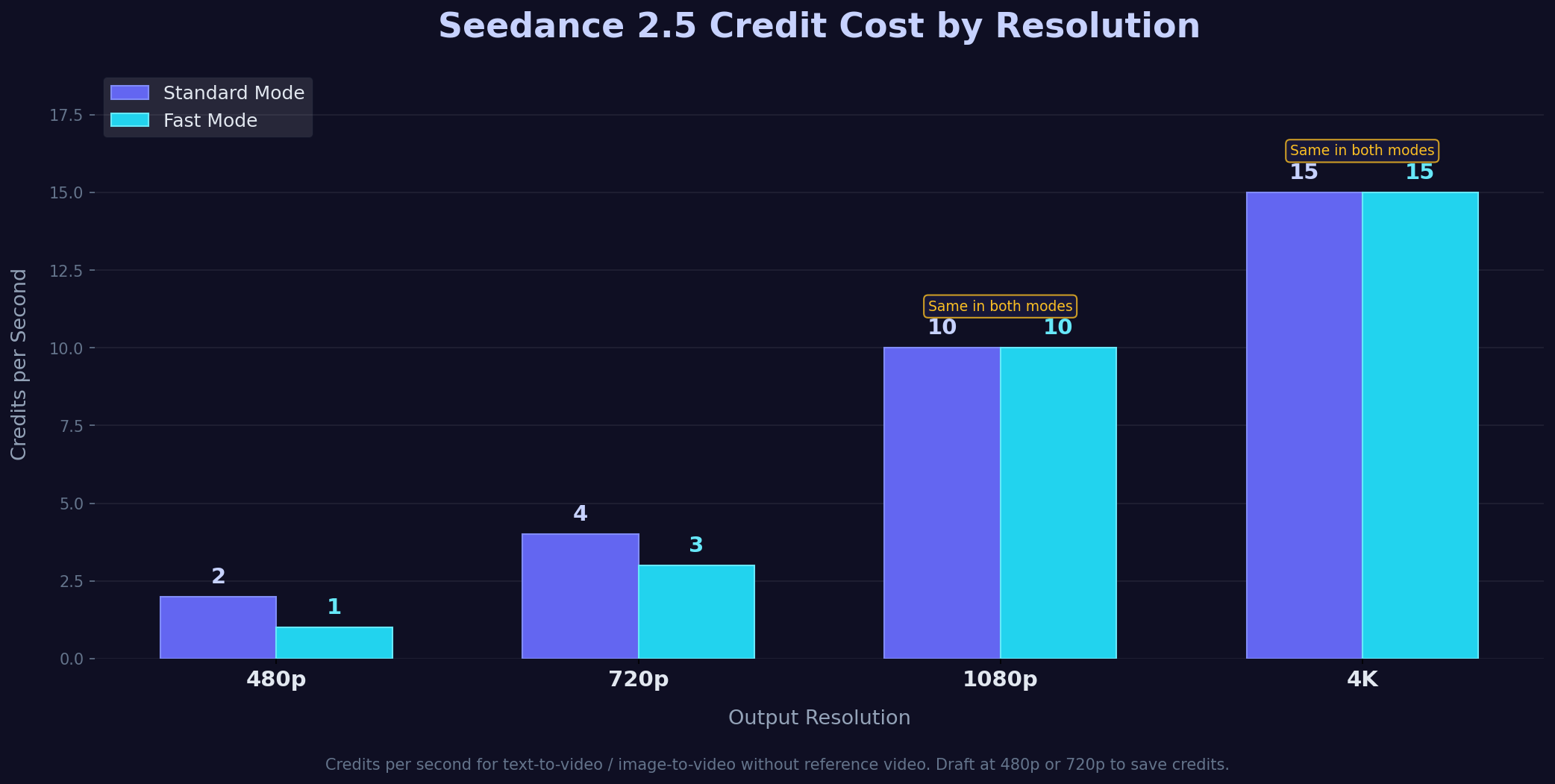
For text-to-video and image-to-video tasks without an attached reference video, the current rates are:
Resolution | Standard Mode | Fast Mode |
|---|---|---|
480p | 2 credits per second | 1 credit per second |
720p | 4 credits per second | 3 credits per second |
1080p | 10 credits per second | 10 credits per second |
4K | 15 credits per second | 15 credits per second |
Fast mode reduces the listed credit cost at 480p and 720p. At 1080p and 4K, Standard and Fast currently use the same number of credits per second. Creators should therefore avoid assuming that Fast mode always produces a cheaper video.
Seedance 2.5 Price per Video
The following estimates show how resolution, duration, and pack size affect the effective Seedance 2.5 price per video.
Video Setting | Credits Required | Starter Value | Basic Value | Plus Value | Professional Value |
|---|---|---|---|---|---|
4 seconds, 480p Fast | 4 | $0.40 | $0.32 | $0.28 | $0.24 |
4 seconds, 720p Standard | 16 | $1.60 | $1.28 | $1.12 | $0.96 |
4 seconds, 1080p | 40 | $4.00 | $3.20 | $2.80 | $2.40 |
4 seconds, 4K | 60 | $6.00 | $4.80 | $4.20 | $3.60 |
10 seconds, 1080p | 100 | $10.00 | $8.00 | $7.00 | $6.00 |
30 seconds, 4K | 450 | $45.00 | $36.00 | $31.50 | $27.00 |
These figures are calculated by multiplying the required credits by the effective cost per credit in each pack. They do not include any additional cost created by a qualifying reference video.
A 30-second 4K generation requires 450 credits before reference adjustments. For this reason, the most economical workflow is usually to validate the concept at a lower resolution and reserve 1080p or 4K for the approved final version. The Seedance 2.5 pricing per video should also be evaluated by usable output rather than first-generation cost — a $2.40 render that needs four attempts ultimately costs more than a $3.60 render that succeeds on the first try.
How Reference Videos Affect Seedance 2.5 Pricing
Reference images, audio clips, and 3D blockouts do not currently change the listed per-second credit rate. However, attaching a reference video of five seconds or longer increases the processing requirement.
Resolution | Approximate Rate with a Reference Video |
|---|---|
480p | 3–4 credits per second |
720p | 6–8 credits per second |
1080p | 20 credits per second |
4K | 30 credits per second |
At 1080p and 4K, a qualifying reference video can approximately double the generation rate. For example, a 10-second 1080p video may increase from 100 to approximately 200 credits, and a 10-second 4K video may increase from 150 to approximately 300 credits.
Reference-video input should not automatically be treated as an unnecessary Seedance 2.5 pricing expense. If stronger motion guidance, camera behavior, or character performance prevents several failed attempts, a more expensive reference-guided render can still produce a lower Seedance 2.5 cost per approved clip.
How Seedance 2.5 Pricing Compares with Kling, Veo, and Sora
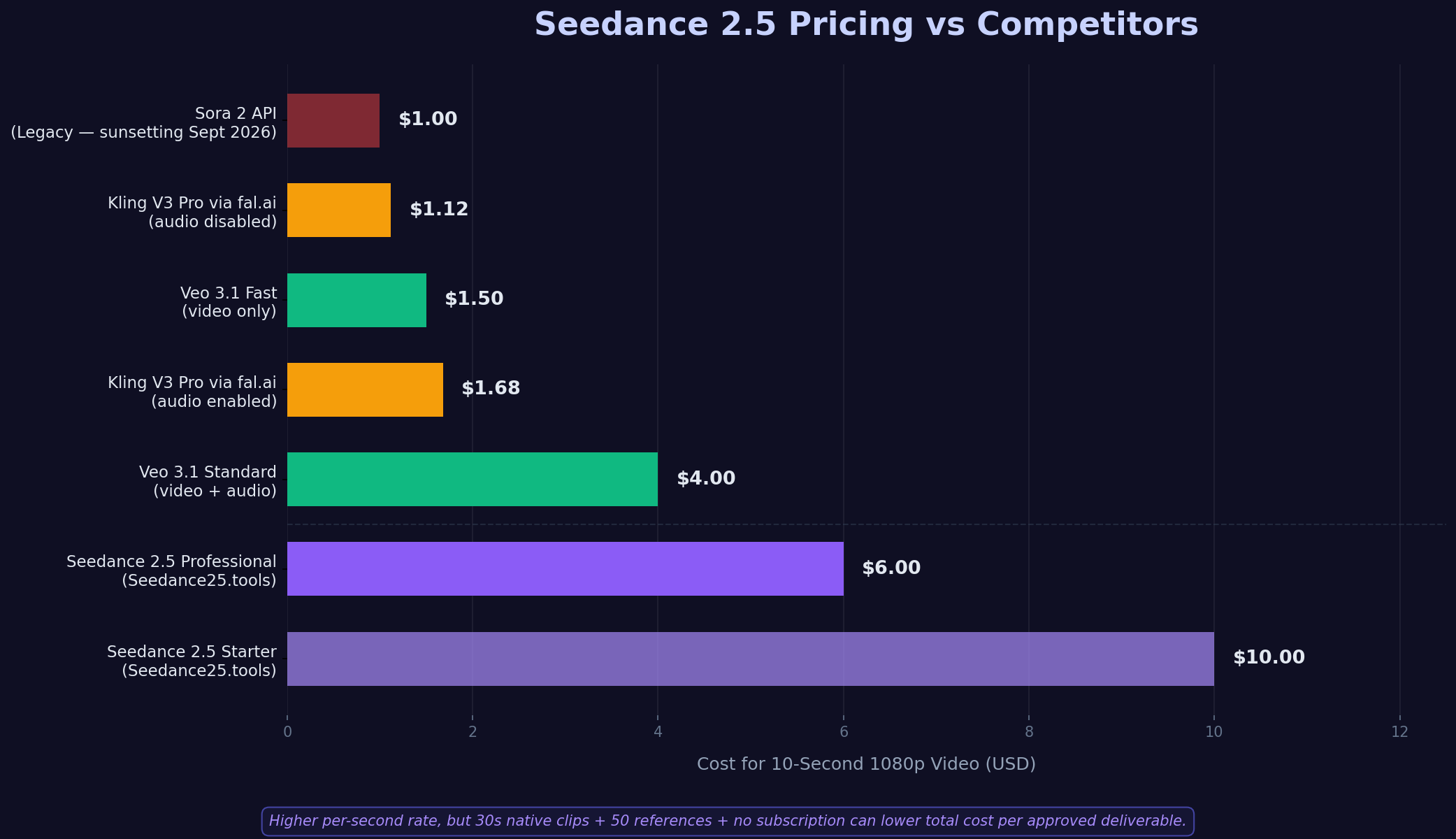
Comparing AI video prices is difficult because providers use different resolutions, audio settings, duration limits, interfaces, and billing systems. The table below presents a simple 10-second equivalent based on publicly listed per-second rates. It is not a model-quality comparison and should not be read as proof that one generator is universally cheaper.
Model and Route | Published Rate | 10-Second Equivalent | Important Pricing Detail |
|---|---|---|---|
Seedance 2.5 on Seedance25.tools, Starter | $0.10 per credit | $10.00 at 1080p | One-time credits; 100 credits for 10 seconds |
Seedance 2.5 on Seedance25.tools, Professional | $0.06 per credit | $6.00 at 1080p | Lower rate through a larger credit pack |
Kling Video V3 Pro via fal.ai | $0.112 per second | $1.12 | Audio disabled |
Kling Video V3 Pro via fal.ai | $0.168 per second | $1.68 | Audio enabled |
Veo 3.1 Fast at 1080p | $0.10 per second | $1.00 | Video only |
Veo 3.1 Fast at 1080p | $0.12 per second | $1.20 | Video and audio |
Veo 3.1 Standard at 1080p | $0.20 per second | $2.00 | Video only |
Veo 3.1 Standard at 1080p | $0.40 per second | $4.00 | Video and audio |
Sora 2 | $0.10 per second | $1.00 | Legacy model; web and app shut down April 26, 2026; API available until September 2026 |
Rates sourced from public API documentation as of July 2026. Kling V3 Pro via fal.ai lists separate prices for audio-off, audio-on, and voice-control generations. Google Cloud separates Veo 3.1 pricing by model tier, resolution, and synchronized audio. OpenAI lists Sora 2 at $0.10 per second and currently labels it as a legacy model with a declining availability window. Always verify on each vendor’s current pricing page.
What This Comparison Means for Seedance 2.5 Pricing
On published unit rates, several API routes have a lower nominal price than a 1080p Seedance 2.5 generation on Seedance25.tools. However, nominal cost per second is only one part of a production budget. The real cost of AI video can also include the number of failed or unusable generations, time spent rebuilding prompts, additional editing and stitching for clips that exceed a model’s native duration limit, reference preparation, subscription fees that are not fully used, queue delays, watermark or commercial-license restrictions, and the cost of regenerating a longer sequence.
Seedance25.tools is most relevant to users who prefer one-time non-expiring credits and a browser-based workflow instead of configuring an API account. For a reader comparing Seedance 2.5 pricing against API-first services, the most useful Seedance 2.5 pricing metric is total cost per approved video rather than unit price alone.
What Every Seedance 2.5 Pricing Plan Includes
Lower-priced packs do not use a reduced version of the Seedance 2.5 model. Every paid bundle includes access to the same model, output up to 4K, watermark-free downloads on paid generations, commercial-use rights under the platform terms, and credits that do not expire.
Commercial permission from the platform does not grant ownership of third-party assets. Users remain responsible for trademarks, copyrighted characters, celebrity likenesses, music, and any other protected material included in prompts or references.
The Seedance 2.5 pricing page also lists a seven-day money-back guarantee for unused credits. Taxes such as VAT, GST, or sales tax may be added during checkout based on the billing location.
See the full plan details and choose a credit pack on Seedance25.tools.
Which Seedance 2.5 Pricing Plan Should You Choose?
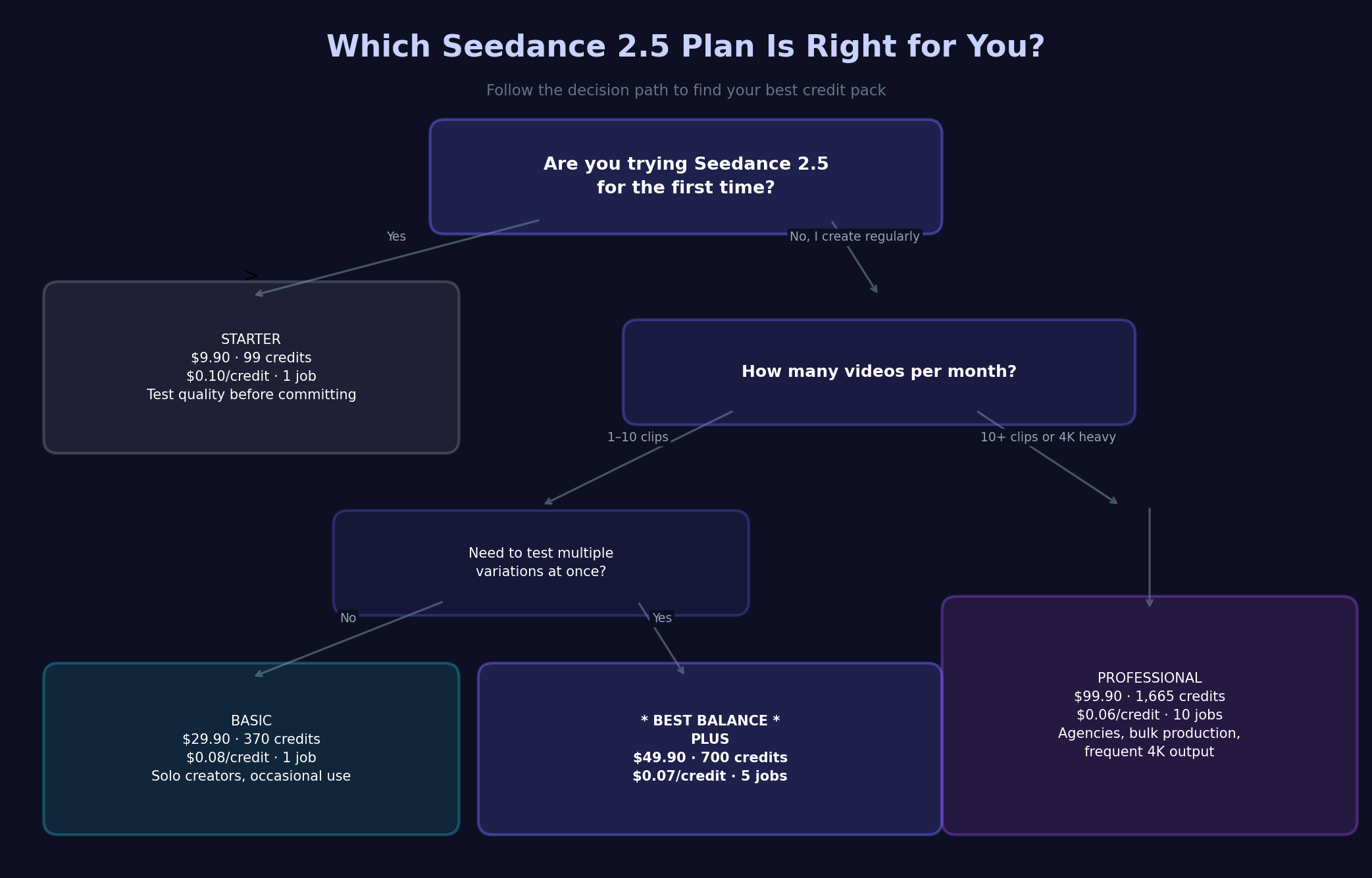
Because every paid pack uses the same model, the best Seedance 2.5 pricing plan depends primarily on expected production volume.
Starter ($9.90 / 99 credits) is appropriate for someone who wants to test prompt adherence, motion quality, or visual style before committing to a larger pack. The 99-credit balance can support several low-resolution previews, approximately two four-second 1080p generations, or approximately one four-second 4K generation. It has the lowest entry price but the highest cost per credit.
Basic ($29.90 / 370 credits) suits solo creators producing occasional social clips, concept videos, or campaign assets. The $0.08 per-credit rate is 20% lower than Starter. Basic includes priority queue access but still supports one concurrent job.
Plus ($49.90 / 700 credits) supports up to five concurrent jobs, making it useful for testing multiple prompts, references, or camera directions at the same time. Before reference-video adjustments, it can support approximately 17 four-second 1080p videos or 11 four-second 4K videos. For many active creators, Plus provides the strongest balance between upfront cost, Seedance 2.5 pricing per credit, and production speed.
Professional ($99.90 / 1,665 credits) provides the lowest cost per credit, the fastest queue, up to ten concurrent jobs, bulk-processing support, and priority assistance. It is most appropriate for agencies, production teams, and creators who frequently run multiple variations or generate longer 4K outputs.
Seedance 2.5 Pricing for Different Workflows
A social media creator producing short vertical content can draft at 480p or 720p and finalize at 1080p — Starter may be sufficient for a single experiment, while Basic or Plus is more economical for weekly publishing. E-commerce and product teams benefit from Plus because five concurrent jobs make it faster to compare hooks, camera angles, and backgrounds, and reference images can guide product appearance without raising the per-second rate. Agencies should calculate the Seedance 2.5 pricing per approved client asset rather than cost per first render — Professional’s lowest rate and ten concurrent jobs reduce both credit expense and turnaround time. Filmmakers can use lower-resolution output for storyboards and previsualization, reserving 1080p or 4K for approved shots and using reference video selectively where exact motion or timing matters.
How to Estimate Your Seedance 2.5 Pricing Budget
Even though the credit packs are not monthly subscriptions, estimating monthly usage can help identify the most economical Seedance 2.5 pricing option.
Estimated credits = number of videos × average duration × credits per second × average attempts per approved video
Suppose a creator needs eight approved 10-second 1080p videos and normally requires two attempts per result: 8 × 10 × 10 × 2 = 1,600 credits. Professional would cover most of this workload in one pack. Now suppose a creator needs eight approved four-second 720p clips at 1.5 attempts on average: 8 × 4 × 4 × 1.5 = 192 credits. Basic would cover this and leave credits for testing.
The most common Seedance 2.5 pricing mistake is calculating only one generation per final video. AI video usually involves iteration — prompt misunderstandings, motion problems, or unwanted details can require another render. A realistic budget should include an average retry factor based on previous projects.
How to Reduce Your Seedance 2.5 Pricing per Clip
Draft at 480p or 720p to test the core concept, subject, action, and camera direction — a low-resolution test can reveal major problems without consuming the credits required for a premium render. Keep early tests short: a four-second generation is often enough to determine whether the model understood the subject, style, and primary movement. Use reference images when appropriate, since they do not increase the listed per-second rate while a reference video of five seconds or longer does. Build reusable prompt templates that define subject, action, environment, camera movement, shot size, lighting, style, timing, and audio behavior — save prompts that work and change one variable at a time. Finally, measure Seedance 2.5 pricing per approved output rather than cost per generation: a more controlled job with stronger references may cost more initially but reduce the total number of retries.
Create a lower-resolution draft before spending credits on the final 4K version.
Is Seedance 2.5 Pricing Worth It?
Seedance 2.5 pricing is most attractive for creators who prefer one-time purchases instead of automatic subscriptions, credits that remain available until used, the same model across every paid pack, 4K access without purchasing the largest bundle, watermark-free output, commercial-use rights, and a browser-based workflow with higher concurrency on larger packs. The weakest Seedance 2.5 pricing value occurs when a user repeatedly generates long 4K videos before validating the prompt — at 15 credits per second, experimentation can consume a balance quickly. The strongest value comes from a staged workflow: low-resolution concept testing, short motion checks, carefully selected references, and high-resolution generation only for approved directions.
Professional provides the lowest Seedance 2.5 pricing per credit, but it is not automatically the best plan for everyone. Starter is better for a first test, Basic fits occasional projects, Plus is the strongest general option for active creators, and Professional becomes economical when volume, concurrency, or frequent 4K production justifies the higher upfront purchase.
Seedance 2.5 Pricing FAQ
How much does Seedance 2.5 cost on Seedance25.tools?
Seedance 2.5 pricing on Seedance25.tools starts at $9.90 for 99 credits. Other one-time packs cost $29.90 for 370 credits, $49.90 for 700 credits, and $99.90 for 1,665 credits.
Does Seedance 2.5 require a subscription?
No. The current packs are one-time purchases that do not renew automatically. Purchased credits do not expire.
How many credits does a Seedance 2.5 video use?
The number depends on duration, resolution, mode, and whether a qualifying reference video is attached. Without a reference video, rates range from 1 credit per second at 480p Fast to 15 credits per second at 4K.
How much does a 10-second 1080p video cost?
A 10-second 1080p generation without a reference video requires 100 credits — approximately $10 on Starter, $8 on Basic, $7 on Plus, or $6 on Professional.
How much does a 30-second 4K video cost?
A 30-second 4K generation without a reference video requires 450 credits — approximately $45 on Starter or $27 on Professional.
Does a reference video increase the Seedance 2.5 price?
Yes. A reference video of five seconds or longer can approximately double the per-second credit rate. Reference images, audio, and 3D blockouts do not currently raise the rate.
Can Seedance 2.5 videos be used commercially?
All paid packs include commercial-use rights subject to platform terms. Users must own or have permission to use all protected input materials.
Does every plan support 4K?
Yes. Starter, Basic, Plus, and Professional all support output up to 4K. Higher resolution simply consumes more credits.
How does Seedance 2.5 pricing compare with Kling or Veo?
Some Kling and Veo API routes have lower published per-second prices. However, the services use different billing models, audio settings, duration limits, and production features. The most useful comparison is total cost per approved video rather than unit price alone.
Is this official ByteDance API pricing?
No. This guide explains the Seedance 2.5 pricing on Seedance25.tools. Other providers may publish different rates and billing structures.
Final Verdict
The Seedance 2.5 pricing structure is straightforward once credits are converted into real production scenarios. Starter minimizes the initial purchase, Basic supports occasional production, Plus offers the strongest balance for active creators, and Professional delivers the lowest credit rate and highest concurrency for agencies and production teams.
The best way to control Seedance 2.5 pricing and video costs is to test short clips at a lower resolution, use reference images where appropriate, track the number of attempts required for each approved output, and reserve 1080p or 4K for final deliverables.
Choose a credit pack and create your next Seedance 2.5 video.